
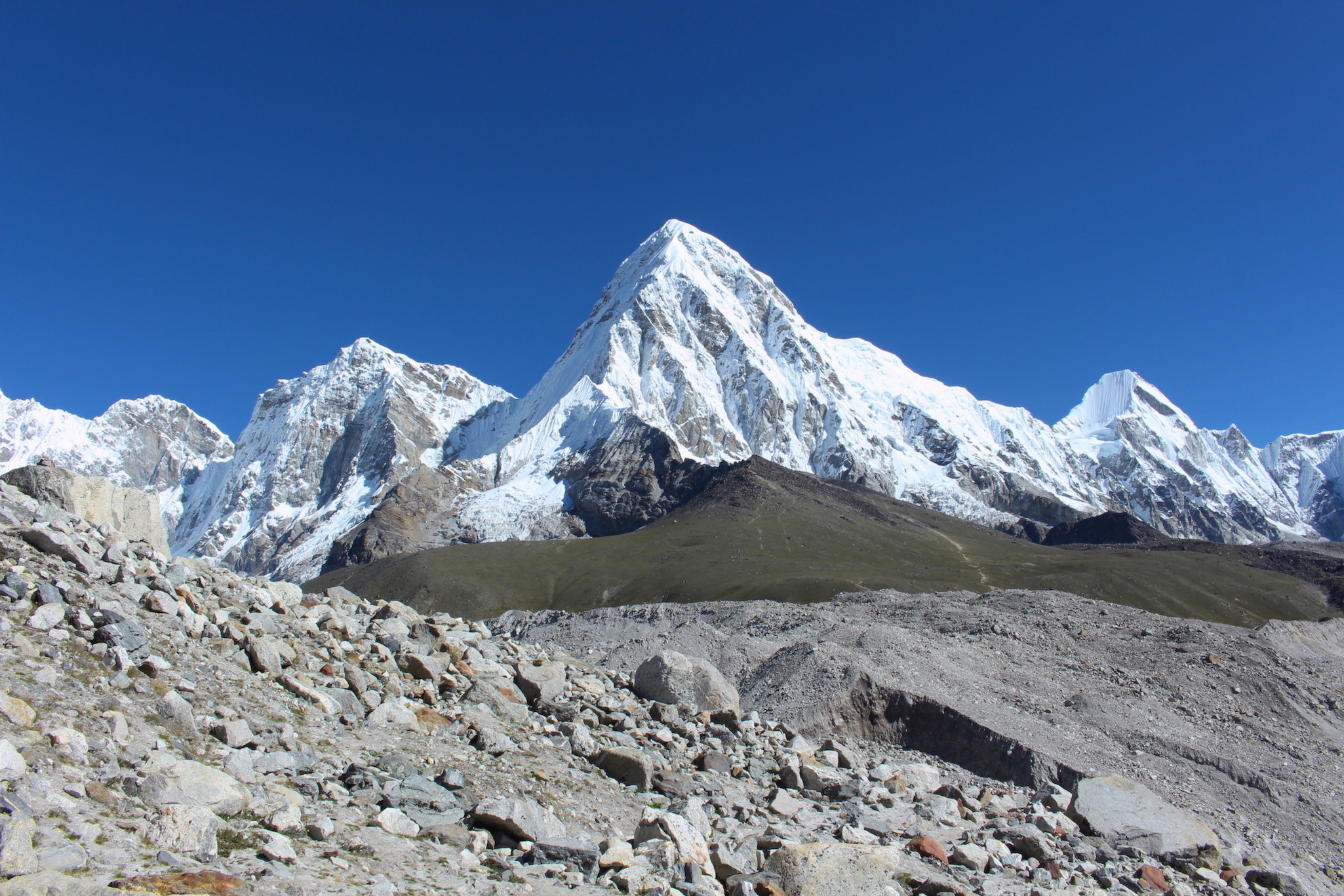









Everest Base Camp & Gokyo Trek combines two incredible himalayan valleys trekking in Everest Region- Everest Base Camp Valley & Gokyo Valley. Major highlights of this trek is, visit to Everest Base Camp (5364m), Incredible view of Mt. Everest from Kalapathar (5545m), challenging but exciting high altitude Chola Pass (5350m), beautiful Gokyo Valley (4800m), Gokyo Ri view point (5357m) & tranquil Gokyo Lakes and Ngozumpa Glacier. No doubt, Everest Base Camp & Gokyo Lake Trek is adventurous and one of the best trekking destinations in the entire Khumbu region. Gokyo Valley is famous for beautiful tranquil lakes in the region, including fourth lakes and fifth lakes valley, and massive Ngozumpa Glacier.
The Everest Base Camp & Gokyo Lakes Trek is a stunning alternative to the traditional EBC route, combining the legendary journey to Everest Base Camp (5,364m) with the serene beauty of the turquoise Gokyo Lakes and the dramatic crossing of the Cho La Pass (5,420m). This route offers panoramic views of four of the world's tallest peaks: Everest, Lhotse, Makalu, and Cho Oyu. You'll pass through vibrant Sherpa villages, visit ancient monasteries, and experience the spiritual heart of the Khumbu region. The trek is physically demanding, especially when crossing Cho La Pass and climbing to Gokyo Ri (5,357m), but the scenery and cultural richness make it one of Nepal’s most rewarding adventures. Adequate acclimatization, stamina, and mental preparation are vital due to the altitude and rugged terrain.
Everest Base Camp & Gokyo Lakes Trek is famous for world highest mountain views including Mt. Everest (8848 m)- top of the world, friendly sherpa peoples and their richest culture and tradition, colorful buddhist monasteries, incredible himalayan valleys and landscapes.

Your safety is our top priority during the Everest Base Camp & Gokyo Lakes Trek with us. Please be aware that trekking in the remote mountainous regions of Mount Everest involves inherent risks, including injury, accidents, and health issues caused by rough terrain, high altitude, and unpredictable weather. Therefore, you should be fully prepared—both physically and mentally—for this adventure trek with us.
During your Everest Base Camp & Gokyo Lakes Trek, we ensure that you are supported by an experienced local guide, a reliable support team, and well-organized logistics to provide the highest level of professional and personalized service—making your journey truly memorable.
Trek itinerary has been carefully designed with a slow walking pace and proper acclimatization to help you adjust to the mountain weather conditions and high altitude throughout the trip. However, please be prepared for flexibility if changes are needed for your health and safety.
Responsible Travel:
Classic Vacations Nepal is committed to Responsible Travel and true sustainability. It was a commitment formed when the company was established, and today, in the face of a multitude of threats to the environment, our commitment is stronger than ever. We aim to ensure that our destinations retain their natural character and cultural diversity for future generations as it is. This vision can only be achieved with the support of all of our travelers and our team effort.
We encourage our customers to be sensitive when it comes to photography and dress code, urging travelers to respect difference, privacy, and modesty. We also consider the effects of tourism on our destinations and promote responsible travel on our trips. We care for the proper wages and proper working conditions for our porters and mountain guides who work with us for our entire trips.
In addition, Classic Vacations Nepal is also working to support rural Himalayan community with coordination with Pioneer Foundation Nepal- www.pfnepal.org, which is non- profitable organization that carries social projects in rural mountains/ Himalayan community in Gorkha, which is one of the rural communities in the country.
At Classic Vacations Nepal, we contribute 5% of your trek cost to social welfare projects in the local community as part of our Corporate Social Responsibility. Learn more about our CSR initiatives at the link below- https://classicvacationsnepal.com/about-us
 1350m
1350m
 6 Km ( Kathmandu Intl. Airport to Hotel)
 25 Min Drive
On your arrival to Kathmandu International Airport, Classic Vacations Nepal officers greet you, then transfer to your trip hotel in Kathmandu. Afternoon, we will meet and have a trek briefing session. You will have an introduction to your trek guide, and support team. Evening, we host a welcome dinner at one of the finest Nepalese restaurants in town.


Hotel Barahi Kathmandu (4 star premium hotel) Or Hotel Shanker (4 star heritage hotel)

Welcome Dinner Included
1350m
40 Km covered in Tour Drive
5-6 Hours Drive
Today, we will take you for a guided tour of cultural and historical highlights of Kathmandu Valley in the afternoon. You will visit Buddha Stupa- One of the biggest Buddhist Stupa in the valley, Pashupatinath Temple- the biggest Hindu temple in town, and Swyambhunath Stupa known as Money Temple, an important Buddhist shrine in the north of Kathmandu valley. Evening, leisure in a hotel. This evening will be your last chance to buy any gear or clothing in town prior to your trek.


Hotel Barahi Kathmandu (4 star premium hotel) Or Hotel Shanker (4 star heritage hotel)
Breakfast Included
2652m
7.8 Km
3-4 Hours Walk
 2.30 Hours
 1 Hour
Today, we fly to Lukla in the morning. This flight is known as an adventurous flight in the mountain airport of Lukla airport, offering some impressive landscapes and mountain views. After a short tea break at a lodge in Lukla, we will start walking toward Phakding. Trail leads down to Dudh Koshi river valley, then continues alongside the river till to Phakding. Today, walking is in great natural and landscape valleys. Evening, we will stroll around the sherpa village of Phakding.
Hotel Pine Forest or similar in Phakding (Attached Bathroom)/ Hot Shower
Breakfast, Lunch, Dinner, Seasonal Fruits & Tea/Coffee
3440m
10.7 Km
6-7 Hours Trek
6-7 Hours ( 788m Ascend)
N/A
From Phakding, the trek to Manjo is gradual up in the valley. Manjo is the entry point to the Sagarmatha National Park. Manjo to Jorsale walk is nice in the green nature along the Dudh Koshi River valley. We will be crossing several suspension bridges at Dudh Koshi River during this section walk.
After Jorsale, a short walk will bring us to Hilary suspension bridge, across the bridge then start walking up the big hill and ascend toward Namche. This walk is steep uphill but a nice walk in subtropical forest. You will have the first view of Mt. Everest from the viewpoint along this hill walk. This ascent to Namche takes about 3 hours on a slow walk. Namche Bazaar, the gateway to all Everest Region treks and climbing and it is the main trading center of this region.
Hotel Camp De Base Hotel or similar (Attached Bathroom/ Hot Shower)
Breakfast, Lunch, Dinner, Tea/Coffee & Seasonal Fruits
3440m
4.5 Km
2-3 Hours Trek
2 Hours (360m Ascend)
1 Hour (360m Descend)
Today is our first day of acclimatization during this trek. While hiking in the Himalayas, as altitude rises, the air pressure drops, and oxygen level drops as well so it makes it hard for breathing. Thus, it is important to spend extra time in altitude so the body can adjust to a high altitude and the thin air. Thus, Namche acclimatization day is planned for this trip.
Leisure morning, breakfast, then we will hike to Everest View Hotel (3800m) for an acclimatized hike. This hike takes about 1 hour and 30 min, and gains about 350m of altitude from Namche. Everest View Hotel offers a stunning panorama of Mt. Everest and the mighty Everest Himalayan range views. After speeding for some time here, we will retrace back to Namche. We will have a free afternoon/ evening in Namche. You may simply relax at your lodge or visit Namche Museum, monastery or stroll around to local sherpa markets.
Hotel Camp De Base Hotel or similar (Attached Bathroom/ Hot Shower)
Breakfast, Lunch, Dinner, Tea/Coffee & Seasonal Fruits
3870m
9.8 Km
5-6 Hours Trek
430m (4 Hours Ascend)
300m ( 2 Hours Descend)
First hour of walking today is pleasant in the valley along the mountain side enjoying the great views of Ama Dablam, Mt. Everest top, and Nuptse. Then the trail descends to the river valley, across the bridge in Imja Khola, and starts walking up a hill up to Tengboche. This part of the walk is through the subtropical forested hill which is uphill but has nice nature, and landscapes.
Tengboche is a nice little place with few guest houses, along with Tengboche Monastery, the biggest Buddhist Monastery of the region. We will take you to visit Tengboche Monastery at the evening prayer ceremony, and have the opportunity to meet and chat with monks in the Monastery. View of Ama Dablam mountain, and himalayan landscapes is incredible from Tengboche.
Trekkers Lodge Or Similar (Attached Bathroom)
Breakfast, Lunch, Dinner / Tea or Coffee & Seasonal Fruits
4410m
10.1 Km
5-7 Hours Trek
540m (5 Hours Ascend)
Trail descends to Deboche for about 30 min in a nice rhododendron forest, then traverses left above Imja Valley in an incredible nature and forest surroundings. We will cross the river bridge, and start a gradual ascend to Pangboche (3985m), a nice Sherpa village.
From Pangboche, walking to Dingboche is mostly gradual uphill in the Imja Valley along the mountain hill. Now, as we are walking above 4000m from sea level, vegetation has changed from greenery to dry and rocky hills. Situated north-west of Imja River, Dingboche is a popular tourist stop in the valley.
Mountain Heritage Hotel Or Similar (Attached Toilet Room)- Hot Shower is provided
Breakfast / Lunch / Dinner, Tea / Coffee & Seasonal Fruits
4410m
5.1 Kms
4 Hours
673m (Acclimatize Hike)
673m (Descend from Nagarjun Peak)
Today is the second (and final) acclimatization day of the trek (first acclimatization day was in Namche two days ago). We will spend two nights in Dingboche for the complete acclimatization in altitude.
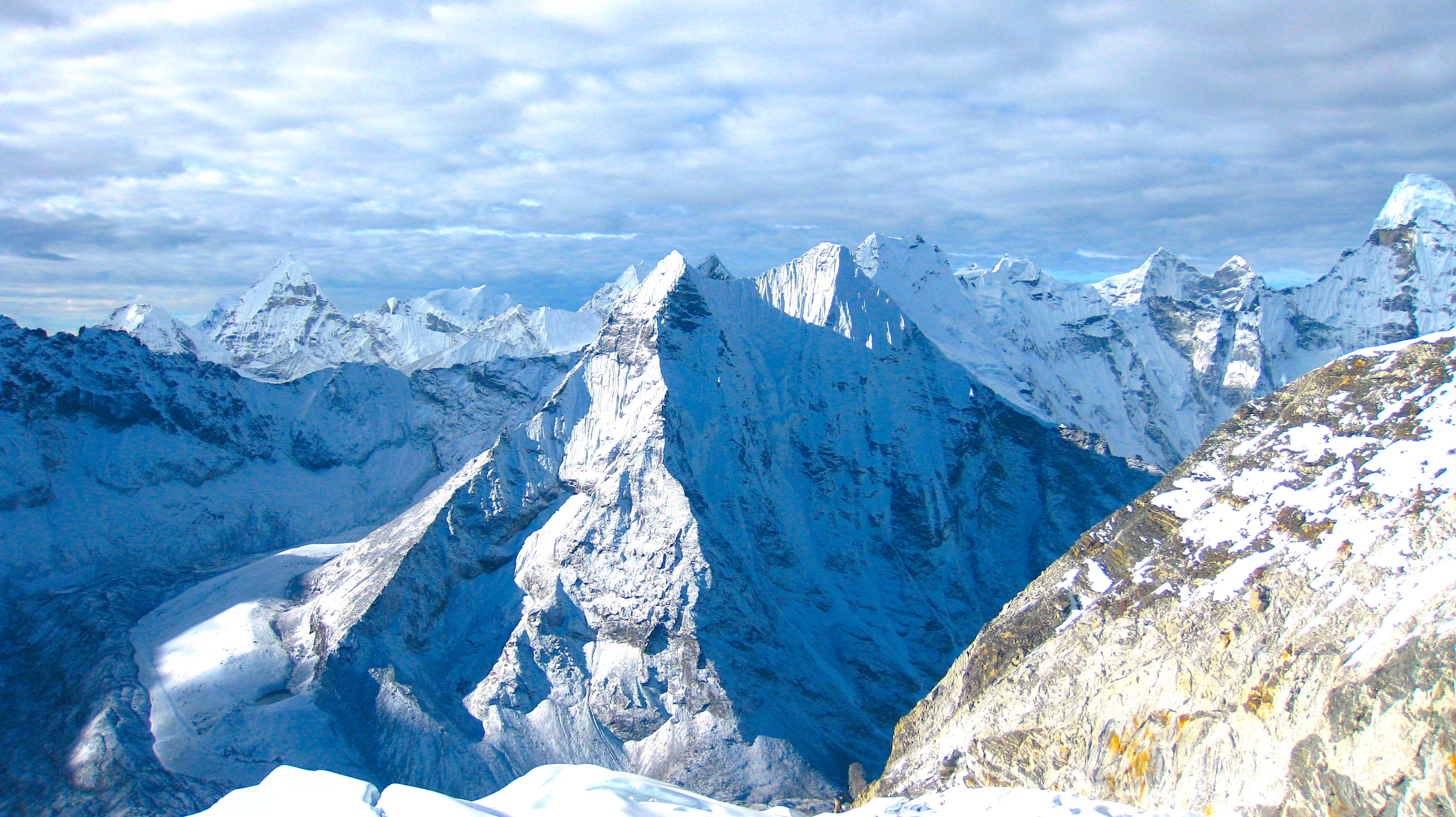
As a part of an acclimatized hike, we will hike to Nangkartshang Peak (5083m). This hike is completely uphill all the way through to the rocky ridge of Nangkartshang Peak, which is right above Dingboche valley. It offers spectacular views of Ama Dablam (6812m), Makalu (8485m), Lhotse (8516m), Cho Oyu (8201m), Island Peak (6091m), Imja Glacier view and surrounding landscape. After enjoying great views from here, we return back to Dingboche the same way down. Lunch and rest in Dingboche.
Mountain Heritage Hotel Or Similar (Attached Toilet Room)
Breakfast / Lunch / Dinner, Tea / Coffee & Seasonal Fruits
4910m
7.9 Kms
6- 7 Hours Trek
500m ( 6 Hours Ascend)
From Dingboche, the trail continues gradually up towards above Pheriche valley alongside the mountain wall then to Thukla, at the bottom of Thula Pass. From here, the hike to Thukla pass is a steep uphill climb through rugged and rocky trails. Top of the Thukla pass is Everest Memorial Park, memorial chortens of climbers who lost their life in Everest climbing. From here, the trek to Lobuche is along the side of Khumbu Glacier.
New EBC Lodge Or Similar (Shared Bathroom)
Breakfast / Lunch / Dinner, Tea / Coffee & Seasonal Fruits
5364m
12.7 Kms
7-8 Hours Trek
454m (Ascend)
204m (EBC to Gorekshep)
Hike from Lobuche is a gradual uphill trail at right alongside the Khumbu Glacier toward Gorekshep. We will cross Pumari glacier prior to reaching the tiny but last Himalayan valley of Gorekshep. Once settled at our room at lodge, and lunch, we get ready for a day hike to Everest Base Camp. Gorekshep to Everest Base Camp trail is a sandy and rocky path alongside the Khumbu Glacier with Nuptse view towering us across the valley.
Final trail reaching Everest Base Camp is actually a walk over Khumbu Glacier itself. Here, you will have several hours to enjoy the glacier surroundings, walk toward Khumbu icefall etc. You have great views of glaciers, ice ridge and Himalayan views. After making best photography and videography at Everest Base Camp, we will return back to Gorekshep for overnight.
March to May is the main expedition season to Mt. Everest and Lhotse mountains, so there will be expedition tents little above trekking base camp., known as expedition base camp. If we trek to Everest Base Camp during these months, we will be able to visit expeditions base camp, and even meet actual climbers preparing to summit Mt. Everest Base Camp.
Hotel Everest Inn or similar (Shared Bathroom)
Breakfast / Lunch / Dinner, Tea / Coffee & Seasonal Fruits
5545m
14.8
6-8 Hours Trek
385m ( Hike to Kala Patthar)
310m ( From Gorekshep) 695m (From Kala Patthar)
Today, in the early morning, we will hike to Kalapathar. Kalapathar is the highlight visit of all the Everest Base Camp Treks. Hike from Gorekshep to Kalapathar is mostly uphill through the rocky mountain terrain. As you get higher closer to the top of the peak, the trail gets steeper and rockier. You will get a quick altitude gain at this hike. Kalapathar hovers just above the Gorekshep, and it is one of the best view points to the incredible and close-up view of Mt. Everest, and surrounding Himalayan peaks, including Lhotse, Lhotse Shar, Pumari, Nuptse etc. Kalapathar offers great Himalayan landscapes, stunning views of Khumbu Glacier and Khumbu IceFall.
After spending a great time here, we will return back to Gorekshep, and will have breakfast. From Gorekshep, retrace back to Lobuche, then will be heading right towards Dzongla valley which is off the main trail to EBC. Dzongla is a small tea house area for overnight before heading to Cho La pass the next day.
Mount Lodge & Guest Houses Run by Sherpa Family (Shared Bathroom)
Breakfast / Lunch / Dinner, Tea / Coffee & Seasonal Fruits
5420m
12 Kms
7-9 Hours Trek
570m Ascend (Dzongla to Chola Pass)
620m Descend (Chola to Gokyo)
With early morning breakfast at a lodge in Dzongla, we start hiking northwest along relatively easy terrain. Once a small stream is crossed, the trail climbs steeply up toward the Chola Glacier through rocky paths. For the final ascent, for about 40-50 min, we will be crossing the Cho La Glacier in the snow and ice section which is a difficult walk over the glacier itself, and the ascent will finally bring us to Cho La Pass. You are rewarded with a magnificent view of the Everest Base Camp Valley & Gokyo Valley from here. Stunning views of Khumbu Himalayas are spectacular from the top.
From the Chola top, a huge steep descent to the valley, then follow a stream down to Thaknag (Dragnak). We will have lunch break here. Final trek to Gokyo Valley is across the glacier moraine of Ngozumpa Glacier, a lot of small ups and downs over the glacier then will be reaching to the other side of glacier. After a short climb to the ridge, followed by an easy trail, we will reach Gokyo Valley.
Mountain Lodge & Guest Houses in Gokyo (Sherpa Owned)- Shared Bathroom
Breakfast / Lunch / Dinner, Tea / Coffee & Seasonal Fruits
4800m
7 Kms
4-5 Hours Acclimatize Hike
N/A
N/A
Today, we will have a day in Gokyo. You may simply rest for a day at Gokyo and walk around Gokyo Lake. In addition, you may hike to the fourth and fifth Gokyo Lakes. You will be walking alongside the Ngozumpa Glacier. Fifth Lake offers an incredible view of Mt. Everest, and surrounding snow capped mountains views, Himalayan landscapes, ice ridges and Ngozumpa Glacier itself. It takes about 4-5 Hours for a day trip to Fifth Lake from Gokyo Valley.
Mount Lodge & Guest House in Gokyo (Shared Bathroom)
Breakfast / Lunch / Dinner, Tea / Coffee & Seasonal Fruits
4200m
16.1 Kms
7-9 Hours Trek
550 (Gokyo to Gokyo Ri)
600m (Gokyo to Dole)
This morning, we will start an early hike to Gokyo Ri for the sunrise of the Himalayas. From the lodge, an easy walk to the base of Gokyo Ri, then the trail constantly uphill climbs to the top of Gokyo Ri. The trail is a sandy and rocky climb to Gokyo Ri.
From Gokyo Ri, you will truly have the best view of the complete Everest region mountains, including a magnificent Mt. Everest, Lhotse, Nuptse, Pumari, Cho Oyu, Makalu and other Khumbu Himalayan panoramas. In addition, you will have an incredible view of Gokyo Valley, Gokyo Lakes, expansive view of Ngozumpa Glacier, and Himalayan landscapes from Gokyo Ri.
After enjoying great views, return back to Gokyo for breakfast. This afternoon, we will hike to Dole. Trail steep down, enjoying the Ngozumpa glacier view at the left, and the incredible Khumbu valley right in front. Trek from Gokyo completely descends to the bottom of the hill to Dole.
Mt. Lodge in Dole
Breakfast, Lunch, Dinner, Tea/Coffee & Seasonal Fruits
3440m
N/A
4-5hrs
Trek from Dole to Namche is pleasant walking in great nature, and landscape valley. Trail descends to Phortse Tenga, then shortly climbs to Mong La. The Imja Valley landscape view from Mong La is incredible.
From here, it is easy walking through rhododendron and alpine forest to Kyanjuma, then a pleasant mountainside walk to Namche. You will have spectacular views of Ama Dablam and other mighty Khumbu Himalayas views along the route.
Hotel Camp De Base Or similar in Namche
Breakfast, Lunch, Dinner, Tea/Coffee & Seasonal Fruits
2800m
N/A
6-7hrs
Today, we will be retracing the same trail that we walked on the 3rd and 4th day of our trek. Trek steeply descends to Hilary Bridge, then a pleasant walk to Monjo, via Jorsale. From Monjo, nature walks to Phakding, then down to Ghat in Dudh Koshi River Valley. From Ghat, we will gradually climb through a nature and scenic trail to Lukla.
It is your last night staying in the mountain region. Lukla is a nice Sherpa village to stroll around. Lukla has ATMs, Banks, Coffee shops, bars etc. You will spend your evening with your trek crew.
Hotel Paradise Or similar in Lukla
Breakfast, Lunch, Dinner, Tea/Coffee & Seasonal Fruits
1350m
N/A
N/A
Morning, fly to Kathmandu. Transfer to your hotel. Afternoon, leisure in Kathmandu. In the evening, we host farewell dinner at the finest restaurant in town. It will be a time for us to talk about your trip, your stories and feedback.
Hotel Ramada or Hotel Shanker in Kathmandu
Breakfast & Farewell Dinner
1350m
N/A
N/A
Today is your leisure day in Kathmandu. This day is used as a back up day for Lukla flights if flight to/out Lukla gets canceled due to adverse weather conditions. You may have a day in thamel for a shopping or leisure walk to Ason local market and Kathmandu Durbar Square.
Hotel Ramada or Hotel Shanker in Kathmandu
Breakfast & Farewell Dinner
1350m
N/A
N/A
Morning breakfast at a hotel in Kathmandu, then you are free from our trip. As per your flight schedule, we provide a departure transfer to the airport, and our services end. Have a safe flight !
Meals: Breakfast
End of the trip!

Nepali Authentic food
Your meals during your stay in Kathmandu will be on a bed & breakfast plan. We will host a welcome dinner and a farewell dinner in Kathmandu. Any additional meals during your stay will be at your own expense.
During the trek, your meals are included as part of our package. You will have a choice of breakfast, lunch, and dinner, as well as tea/coffee during your trekking days with us. We will source food for your group from guesthouses, prepared by trained local chefs. We take care to ensure that your food is fresh and hygienic.

Hotel Room
For this Trek, we use 4-star deluxe luxury hotels in Kathmandu, Hotel Barahi Kathmandu Hotel Or Hotel Ramada Thamel, Kathmandu to ensure your stay is comfortable.
During the trek, you will be staying in mountain lodges and guest houses owned by local Sherpas, offering a nice and comfortable experience. You will have attached bathroom and hot shower facilities during your stays in Namche & Lukla, while other places will have regular mountain lodges.
We are team of professionals who share a common devotion to the outdoors and are commited to world travel.
Mr. Lok Bhatta is one of our best and professional guide in the company. He has been guiding with us from last 12 years. He have trekked over to our major trekking region of- Everest Region, Annapurna Region, Mustang Region, Manalsu Region, Langtang Region etc. He is...

Originally from Khumjung- 3, Everest Region, Mr. Pema Chhosang Sherpa is our key climbing guide for major peaks in Everest region, including Island Peak, Lobuche Peak, Kyajo- Ri Peaks and other 7000er climbing in the region.
Mr. Pema is 15 + years...

Mr. Pem Chhotar Sherpa was born in Solukhumbu. He lived in his village for 16 years and studied under a Lama called Tawa in local language. He used to work as a porter while in Solukhumbu. His maternal uncle has a trekking company and he w...

Here, we have published our private & small group departures dates for this trip. If these published dates does not fit your travel date, write to us with your date, and we will be very pleased to organise this trip at your desired date and time requested.

Things to explore more..

Advice to Novice Travelers:
If you are one of those outdoor devotees then tour and trekking in Nepal should be at the top of your bucket list. If you are new to the Himalayas then you might be wondering how it is like trekking/ tour under those majestic white Himalayas and what are the things to be considered before preparing for trekking in Nepal. Here are some basic guidelines (tips) that you should consider to make your adventure in Nepal a lot easier and enjoyable.
Passport & Nepal Visa Information:
You must have a valid passport, which should remain valid for at least six months beyond your planned stay in Nepal. Nepal visas can be easily obtained on arrival at Kathmandu International Airport or any other entry point that you are entering to Nepal.
Alternatively, you can also apply for a Nepal visa in advance through a Nepalese consulate or embassy abroad. For convenience, you can fill out the Nepal Visa form online, here is the link-
https://nepaliport.immigration.gov.np/
Travel Insurance & Vaccination:
Travel Insurance is a must for undertaking any tours, treks and mountaineering activities in Nepal with us. Your travel insurance should cover for medical expenses, helicopter evacuation and trip cancellation during your trip days in Nepal. In addition, your travel insurance should also cover for flight delayed, checked in baggage lost, Passport lost etc.
Traveling to Nepal, Covid-19, Hepatitis A, Hepatitis B, Japanese Encephalitis, Malaria, Rabies, Typhoid, Dengue, Yellow Fever vaccine are highly recommended.
Health & Medical Condition:
You should be in good health and mentally fit to plan any tours, trekking and mountaineering with Classic Vacations Nepal. If you have any pre-medical condition, or disability, you should let us know prior to your trip booking with us. We deserve not to take you on our trip if your medical condition is extremely poor or the trip does not suit your disability.
For pre-medical conditions or any disability person, we may request you to provide us with your doctor's advice and certificate certifying that you are fit for your trip to be booked with us.
Children in the Trip:
Children below 16 years should be accompanied by their parent or guardian to take part in any trips with Classic Vacations Nepal. So, children below 16 years are not allowed to join our tours without a parent or guardian.
Packing Guidelines:
It is important to pack the right clothing and equipment for your safe adventure trip in Nepal. Please prepare to pack the right clothing for a safe and pleasant trip. What you need to pack mostly depends on the different seasons you travel, and how high you go. You will be walking from low valleys to high valleys, so it is important to have enough layers to use it at appropriate weather conditions and altitudes.
Here we have a reference for packing to your adventure travel with us, which should be very helpful.
Head Gear: Sun Cap/Hat Beanie/ Woolen Hat or Fleece Hat, Neck Gaiter or Buff or Balaclava
Hand Gear: Liner Gloves, Wind Stopper Fleece Gloves
Foot Wear: Regular Hiking Socks, Heavy Socks, Sports Sandals, Hiking Shoes, Hiking Boots, Snow Gaiters (Optional), Micro Spikes (Optional)
Inner Wear: Under Wear, Sports Bras (Female)
Clothing: Lightweight Thermal Layer Top & Bottom, Midweight Thermal Layer Top & Bottom, Hiking Pants, Thermal Trousers/ Pant or Fleece Trouser or Pant, Synthetic Insulated Pant or Gore Tex Pant, T- Shirts (Short Sleeved), Long-Sleeve Shirts, Fleece Jacket, Gore Tex Jacket or Synthetic Insulated Jacket, Down Jacket
Travel Gear: Day Pack, Pack Cover, Waterproof Stuff Sacks, Water Bottles, Trekking Poles, Pocket Swiss Knife, Small Padlocks
Medical & Personal: Sun Glasses, Headlamp with spare bulb, Spare Batteries, Sun Cream, Lip Guard, Moisturizer/ Lotion, Zip-loc Bags, Earplugs, Water Purification Tablets,
Toiletry Kit: Toilet Paper, Wet Tissue, Toothpaste, Tooth Brush, Soap, Towel, Garbage Bag etc.
Others: Book(s) & Camera, Power Banks, Extra Batteries for Camera etc.
First-Aid Kits including Diamox & Oximeter
Accessories: Nail Cutter, Umbrella/RainCoat, Hot Water Bag, Pee Bottle & Pee funnel for women (optional), Tenacious Tape Repair Kits
Book with Local Agency:
Locals know it all, they are well updated to the current situation, trekking routes, and they are far more reasonable than international agencies. Local agencies are far more flexible when it comes to dates, rates and customization than international agencies.
Know About Altitude Sickness:
Before any trek, you should consult with your health professional for the relevant immunizations and information regarding medication and altitude. The key in our experience is to allow plenty of time for your body to adjust to the altitude – you can't rush the mountains – and we abide by the climber's maxim – "climb high and sleep low”. We especially encourage those travelers from areas of low sea level to always have a little more time up their sleeve so they can allow for extra rest days if needed. Trekking in Nepal means you are walking above 2500 meters, resulting in a high chance of suffering from altitude sickness no matter how fit you are. The altitude sickness mostly occurs above 2400m (8000 feet) and most people can ascend to this altitude without difficulty. However, it is hard to tell who will be affected by Altitude sickness because everyone reacts to altitude differently.
Symptoms of Altitude Sickness, Headache, Nausea and dizziness, Shortness of breath, Loss of appetite, Fatigue, Difficulty in sleeping, Lack of body coordination. The most effective way to cure altitude sickness is to stay alert for its symptoms, and if you or any member of your trekking group suffers from it descend to lower elevations as quickly as possible.
Treatment: Diamox (Acetazolamide):
Diamox (Acetazolamide) allows you to breathe faster so that you metabolize more oxygen, thereby minimizing the symptoms caused by poor oxygenation. Contact your physician for a prescription. Since Diamox is a sulfonamide drug, people who are allergic to sulfa drugs should not take Diamox. Diamox has also been known to cause severe allergic reactions to people with no previous history of Diamox or sulfa allergies.
Walk at your own Pace:
Walk slow and steady, rather than having to walk faster and stop frequently. Stop when you want to, sit back and relax, catch some breath, feast your eyes with the panorama, and take plenty of photographs. There are no rewards for those who reach or complete the trek first. By being slow and steady, you keep your heartbeat fairly constant, use less energy and cover more distance. There are also a couple of rest days which are included in the itinerary, to get acclimatized to high altitude, before going any further up. So, do not rush, the Himalayas are there and aren’t going anywhere.
Know About Nepal:
Before heading to Nepal, learn and get to know about Nepal. Do little homework about the culture and lifestyle, a bit of geography and history. It will surely come in handy and even help you overcome some of the cultural shock you (tourist/travelers) may face in Nepal. Also learn some basic local phrases to get you through Nepal.
A simple Hi/ Namaste or Thank You with a smile will definitely break the cultural barrier with the locals and help you get through loads of difficulties.
Drink Fluids/ Water:
You tend to get dehydrated quickly when trekking in high altitude. So, drink plenty of fluids and water during your treks in Nepal to keep yourself hydrated.
Note: Fluid does not mean beer or any other alcoholic beverages.
Listen to your Guide:
Our every trip will be accompanied by the most experienced local guides and support team. Please trust your guides. Our team ensures that every aspect of your trip runs smoothly once you depart for your desired tour, trekking and/or climbing destination. Tell your problems to your guide, don’t hide them. Your trekking guide should be aware of these risks and will always be looking out for your safety and wellbeing.
What other travelers has to say about us:
You may be interested in knowing more about our company services, and our guides and our professionally guided trips, and if so, you are welcome ! Here is the link of Tripadvisor where our guests have shared their trip experiences with us, please kindly view at- https://www.tripadvisor.com/Attraction_Review-g293890-d25053369-Reviews-Classic_Vacations_Nepal_Pvt_Ltd-Kathmandu_Kathmandu_Valley_Bagmati_Zone_Central_.html
More Information:
Are you not satisfied with information provided here or are you still willing to more information about the trip, please feel very free to contact us at [email protected] or WhatsApp at +977 9851040806.
Thank you ! Happy Holidays !!!
Everest Base Camp & Gokyo Lakes Trek is a fairly demanding trek in the Everest Region. This trek is not a technical climb, however, walking over to Cho La required walking in glacier and ice sections so it is a difficult part of this trek. You should come with micro spikes which will help the Cho La walk easy and safe. You should be in good health and physically in shape to plan this trek. Mental strength and determination is equally important. You will be walking in altitude above 4400m for a week so trek days could be tough due to altitude and longer hours of walking every day. If it snows heavily at high altitude areas, trek trails will become slippery and walking will be difficult.
The best training and preparation for this trek is to improve cardio endurance. You should be training yourself for a minimum of 3 months prior to this trek adventure. Carrying a day backpack and walking uphill/downhill for several hours every day (4 days in a week) helps you to prepare the best for this adventure hiking in Everest Base Camp & Gokyo Lakes. Swimming, cycling and running will build up your cardio endurance. You may join a Gym and focus on cardio training.
Your trek is guided by the most experienced local trekking guides from Nepal. Our guides are licensed and trained from Nepal Government, Department of Tourism & Nepal Academy of Tourism & Hotel Management (NATHM). Our trek guides are fluent English speaking, eco trained, first aid and altitude trained, and guiding in Nepal Himalayas over 15 years. So, while trekking to Everest Base Camp & Gokyo Lakes, you are in safe and professional hands.
Yes. This trek is a high altitude trek for two weeks in the Himalayas so you would have enough and correct trek gear, clothing and equipment to keep you safe in cold weather and temperature. You will also need sleeping bags, and Down Jacket to keep you warm on trek days. So, you would not be able to carry all your trek gear as you trek, thus a trek porter is necessary to carry your trekking bag. Every two trekkers get one porter to carry trek luggages at our trek. You will only carry your day pack (light one with your valuable belongings and day use jumper or jacket).
You will be staying in Mt. Lodges & Guest Houses during trekking in Everest Base Camp & Gokyo Lakes Trek with us. Lodges are runned by the local Sherpa community peoples, in coordination with lodge management committee of Everest Region. We will be using the best available Mt. Lodges & Guest Houses throughout this trip. Staying in Lukla and Namche has nice and comfortable Lodges with an attached bathroom/ hot shower. Other places will have neat and clean rooms, and comfortable. We use rooms at twin share accommodation.
Yes, a full board of meals are included at our trek. You get a choice of healthy and hygienic breakfast, lunch and dinner in our package. You get a choice of veg. meals, breads, eggs, rice, curry, potatoes, macaroni, spaghetti, pizza, noodles, soups etc. At lower valleys, you get a choice of chicken meat as well
Yes, you have electricity at every lodge during this trek. They are hydro electricity. Some guest houses have solar systems for backup electricity as well.
Ideally, you will be purifying the spring water available in lodges and drinking it. You could bring SteriPEN or any other water purification tablets to purify the drinking water at this trek. You will be able to buy mineral water throughout the trek days too. Boiled drinking water is available at every guest house as well.
If you could not cross Cho La, we will be returning down to the Pheriche, then to Pangboche valley. Now, you have the choice of taking an alternative route to Gokyo to Phortsa Tenga, Dole & Gokyo. Or, you may simply return back via exploring the hidden valleys of Khumjung, Thame etc. then to Namche, and Lukla. Cho La is usually always open but if it has heavy snowfall or an avalanche at Cho La, this route could be closed for some days till the snow melts out.
If any of our trekkers gets sick during the trek, he/she will have to stop ascending. We will have one of our assistant guides accompany him/her, whereas other group members could continue the trek as per the trek schedule with the lead trek guide and porter/s team. We will make sure that sick person is well looked after, and stay safe. If he/she is able to descend slowly, we shall retrace back. However, if altitude sickness worsen, and become life threatening, we will bring them back to Kathmandu by helicopter evacuation at earliest possible for further treatment at the hospital. So, trekkers should come with travel insurance with coverage of helicopter evacuation for emergency health issues.
In/Out Lukla flight is weather dependent so it is likely that flight gets delayed often. Your guide will have an update of your Lukla flight in the event of delays. Even at best trekking months, flights to/out Lukla get canceled due to bad weather. If the flight is canceled, we will reschedule your new flight for the next day. Lukla is the most adventurous flight in a tiny mountain airstrip, known as one of the most dangerous flights in the world. However, this sector flight is usually very safe. Due to air traffic congestion in Kathmandu airport, flight to Lukla is now operated from Ramechhap airport, which is about 130 kms north-east out of Kathmandu, and takes about 3 hours and 30 min drive.
Classic Vacations Nepal is a Travel Company based in Kathmandu, Nepal run by a team of young and energetic travel guides experienced in adventure travel from 22 years. Trip safety and quality trips are our first priority. Classic Vacations Nepal is a responsible Travel Company. We ensure zero impact for the nature, culture and the environment we travel on our trips.
Here are a few reasons why you should travel with Classic Vacations Nepal.






 Google
 Tripadvisor

